


With Rubaiyat, French perfumer Anatole Lebreton takes us far back in time – to the 11th century to be precise. To the time in which the Persian mathematician, astronomer and philosopher Omar Chayyām lived. Chayyām was a polymath whose work had an impact far beyond his own era: He provided significant mathematical insights, contributed to the reform of the Persian calendar and dealt intensively with questions of time, order and transience.
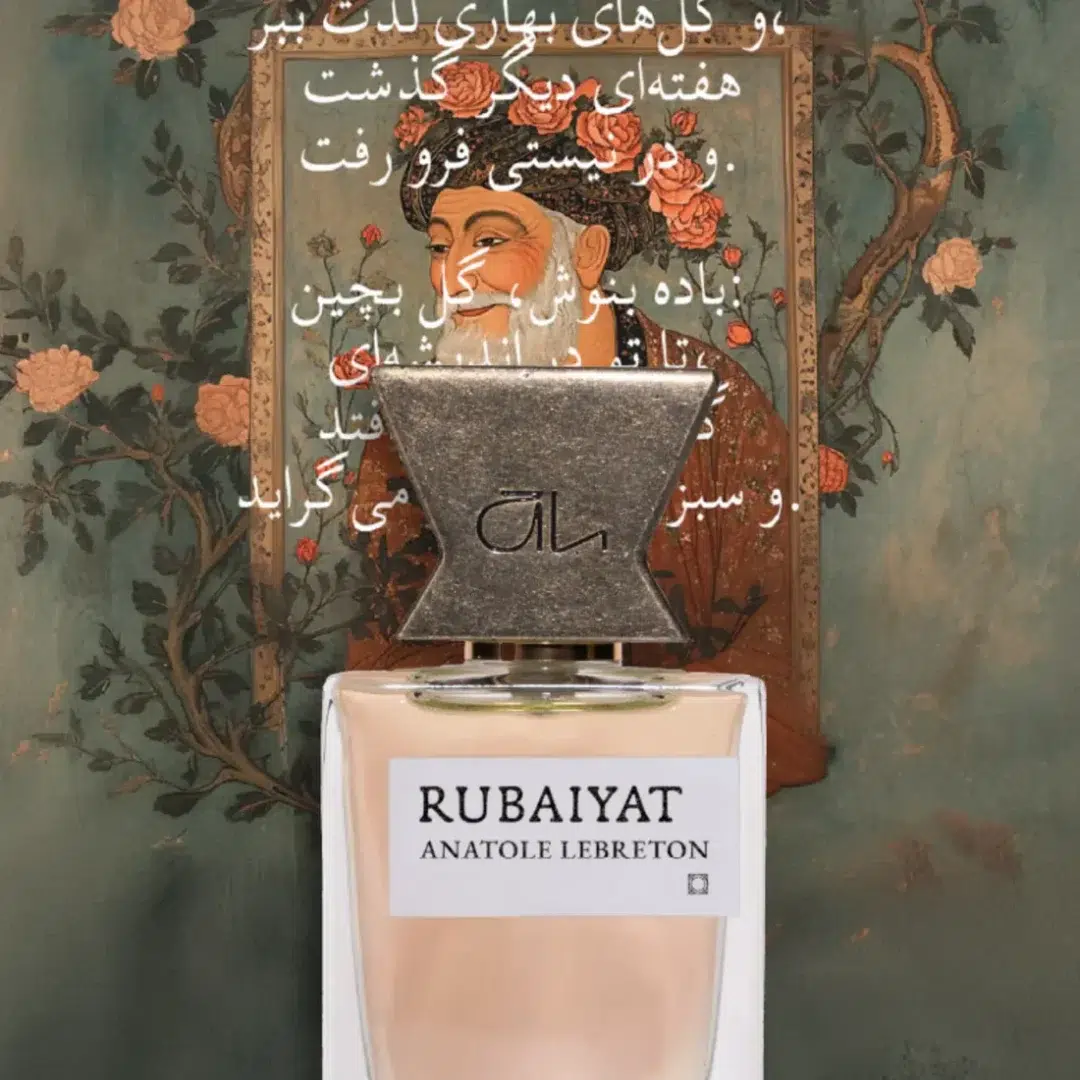
In addition to his scientific and philosophical studies, Chayyām also wrote poetry. However, his quatrains, the so-called Rubāʿīyāt, only became known to a wider audience long after his death. This was largely due to the free English adaptation by the British writer Edward FitzGerald in the 19th century, which reinterpreted Chayyām’s world of thought and at the same time had a lasting impact on the Western image of the poet.
Quatrains between doubt and devotion
The Rubāʿīyāt themselves follow a strict, clear form. Each quatrain is self-contained, condensed, often pointed. In just a few lines, a train of thought unfolds that rarely provides answers and instead sows doubt all the more frequently. The poems deal with the transience of life, the fragility of certainties, pleasure and intoxication as well as skepticism towards religious and moral dogmas.
Characteristic of Chayyām’s quatrains: they oscillate between rational thinking and sensual experience, between a thirst for knowledge and devotion to the moment. Wine, roses and love appear less as mere symbols of hedonism and more as an expression of a quiet, almost stoic acceptance of one’s own finiteness. True to the credo: seize the moment, because life can be over all too quickly.

Rubaiyat – Roses and wine
With the fragrance notes of cardamom, Turkish rose, wine, pepper, raspberry, myrrh, cashmeran and caramel, the Rubaiyat fragrance by Anatole Lebreton takes up the theme of pleasure and intoxication, to which Omar Chayyām’s quatrains, which serve as inspiration, are repeatedly dedicated. Wine, ripe berries and lushly blooming roses meet spices and warm, cozy accents to create a composition that celebrates conscious abandon rather than excess.
Rubaiyat by Anatole Lebreton in the test
Light, airy rose nuances open the fragrance: fresh, delicately floral and with a gently soapy clarity. Cardamom and pepper bring spicy facets into play, while the rose combines with the sweet and sour accents of raspberry as the fragrance progresses. The wine adds a fine tartness and darker nuances to the composition, giving Rubaiyat depth and volume. The initially light-hearted, almost youthful rose seems to gradually mature. It becomes more sensual, more mature, more mysterious. Soft, enveloping notes come to the fore at the end. Cashmeran provides a calm, gentle comfort, accompanied by the creamy sweetness of caramel, which lends the fragrance a subtle, restrained sweetness without allowing it to tip over into gourmandism.
Anyone expecting opulent rose fragrances or a dominant wine scent will not find what they are looking for in Rubaiyat. The eau de parfum is quiet, calm, almost contemplative. A composition that should appeal to all those who prefer finely balanced, clear and gradually evolving creations and love rose. With a medium presence and good longevity, Rubaiyat is a unisex fragrance with a feminine tendency that wears particularly well in the cooler seasons, but also on quiet evenings in spring or fall. Not a fragrance for grand entrances, but for moments of seclusion – elegant, warm and unagitated.

Be First to Comment